A fish finder can make a kayak or small boat far more useful for locating depth changes, structure, and suspended fish. The best models for compact craft are easy to read, simple to mount, and practical to power without adding much weight or clutter.
For small boats and kayaks, a clear screen, dependable depth readings, and a mounting setup that avoids unnecessary drilling matter more than a long list of advanced features. Buyers should also check transducer placement, operating depth, battery requirements, water resistance, and whether the unit is portable enough for their fishing style.
Best for GPS navigation and all-around use: Garmin Striker 4 with Transducer
Best for simple dual-beam sonar: Humminbird PiranhaMAX 4
Best for handheld depth scouting: LUCKY FFC1108 Portable Fish Finder
Best for a rechargeable wired unit: LUCKY Portable Fish Finder
Best for wireless castable sonar: Fuceter Portable Castable Fish Finder
Garmin Striker 4

Buy this model for a compact fish finder with useful GPS waypoint marking, CHIRP sonar, and a straightforward button-driven interface.
Pros
- GPS waypoint map for marking productive spots
- CHIRP sonar improves fish-target separation
- Compact, easy-to-use design with included mounting hardware
Cons
- Small 3.5-inch screen
- Installation may require adapting the transducer for a kayak
- The included setup is better suited to fixed mounting than quick cast-and-retrieve use
The Striker 4 is the strongest all-purpose choice here for anglers who want more than basic depth readings. Its waypoint map lets users mark brush piles, docks, and other locations, then navigate back to them later. CHIRP sonar produces clearer fish arches than a basic single-frequency display, while the built-in flasher mode is useful for vertical jigging or ice fishing.
The screen is small, though, so it works best when mounted close to the seat. Kayak owners can install the transducer on a trolling motor, use a through-hull approach, or create a removable mount. The unit is rated IPX7 and supports depths up to 1,600 feet in freshwater under suitable conditions.
Humminbird PiranhaMAX 4

This is a good choice for beginners who want a larger, uncomplicated display and basic sonar coverage without GPS features.
Pros
- 4.3-inch screen is easier to view than smaller displays
- Dual-beam sonar offers detail or wider coverage
- Tilt-and-swivel mount simplifies viewing-angle adjustments
Cons
- No GPS or waypoint mapping
- Maximum stated depth is lower than the Garmin’s
- Transom mounting may require extra care on compact boats
The PiranhaMAX 4 focuses on the essentials: fish, bottom contours, and depth. Its dual-beam sonar lets anglers switch between a narrower beam for more detail and a wider beam for surveying a larger area. The color LCD is more comfortable to read than a tiny monochrome display, especially when the unit is mounted within arm’s reach.
The included tilt-and-swivel mount is convenient for a small boat, though kayak owners may need a rail adapter or removable mounting plate. One practical installation detail is worth noting: the transducer should sit flush and securely enough to avoid turbulence that can interfere with readings.
LUCKY FFC1108 Portable Fish Finder
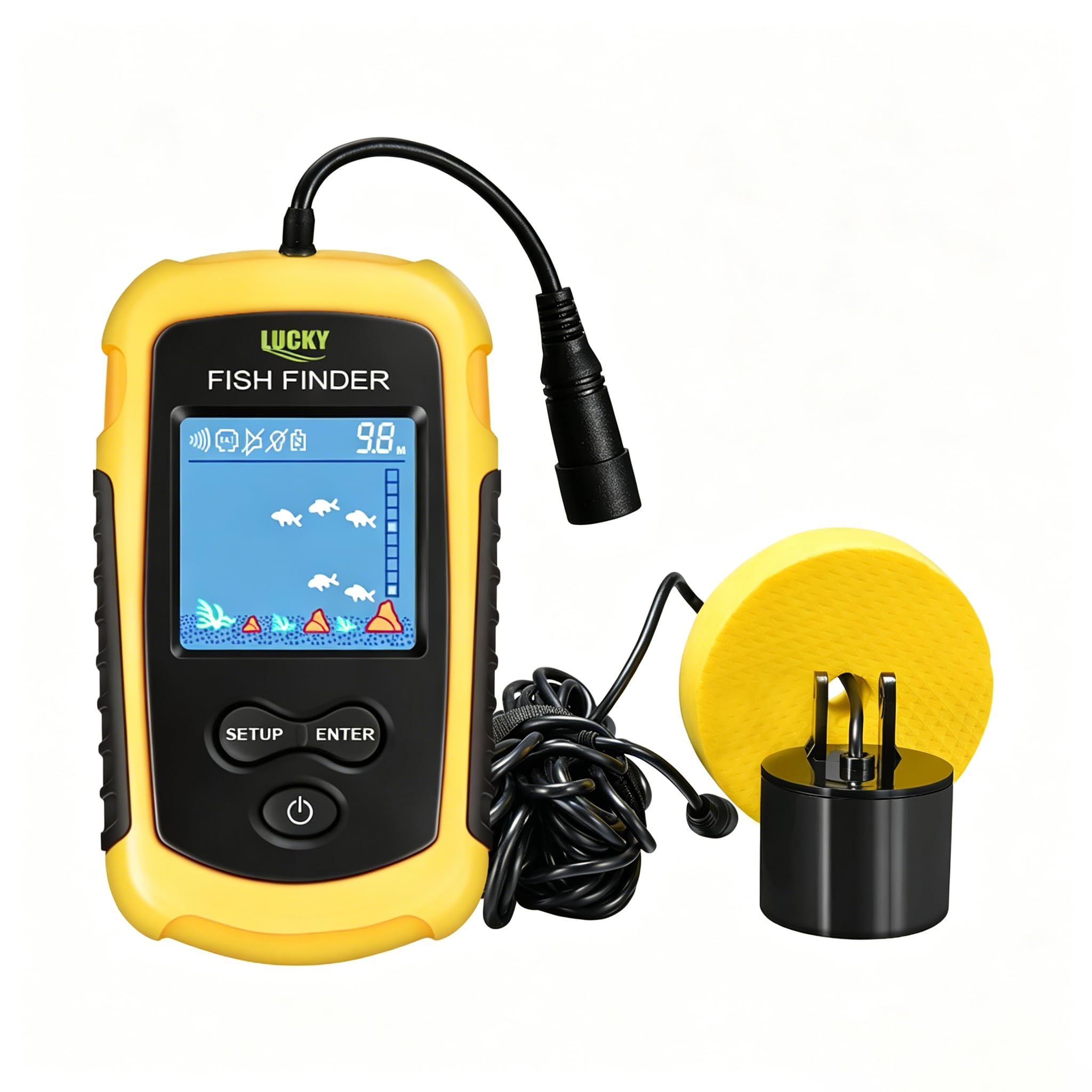
Choose this handheld unit for lightweight depth scouting from a kayak, canoe, rental boat, or temporary fishing platform.
Pros
- Handheld design avoids permanent installation
- Neck strap makes it easy to carry on a kayak
- Displays depth, bottom features, and fish alerts
Cons
- Small 2-inch screen
- Readings can be less consistent in motion or poor conditions
- It is less capable than a mounted GPS fish finder
The FFC1108 is particularly practical when drilling into a hull is not an option. Its transducer can be attached to a kayak or boat hull, and the handheld display can remain within reach or hang from its strap. Five sensitivity levels help accommodate clearer or more turbid water.
The display identifies approximate fish locations and can show weeds, rocks, and sand on the bottom. It is also useful simply as a depth scout when moving around unfamiliar water. Anglers should treat fish icons as indications rather than exact fish identification, especially when paddling or drifting.
LUCKY Portable Fish Finder

This rechargeable wired model suits anglers who want a portable color display with more adjustment options than a basic handheld depth finder.
Pros
- Rechargeable battery and approximately five-hour operating claim
- Color screen shows bottom contour, depth, temperature, and fish icons
- Adjustable sensitivity, brightness, zoom, alarms, and measurement units
Cons
- The handheld display is not waterproof
- Fish icons can produce false positives around weeds
- Wired transducer limits placement flexibility
The 2.9-inch color display gives this unit a useful balance between portability and readability. It can show water temperature, depth, bottom shape, and approximate fish size, while simulation mode lets beginners explore the controls before launching.
The 26-foot cable is workable for many kayaks and small boats, especially when the sensor is secured near the hull. The rechargeable design eliminates disposable batteries, though the display should be protected from splashes and stored safely between uses. For anglers who primarily need depth, shelves, and bottom contours, it offers substantial functionality for a modest setup.
Fuceter Portable Castable Fish Finder
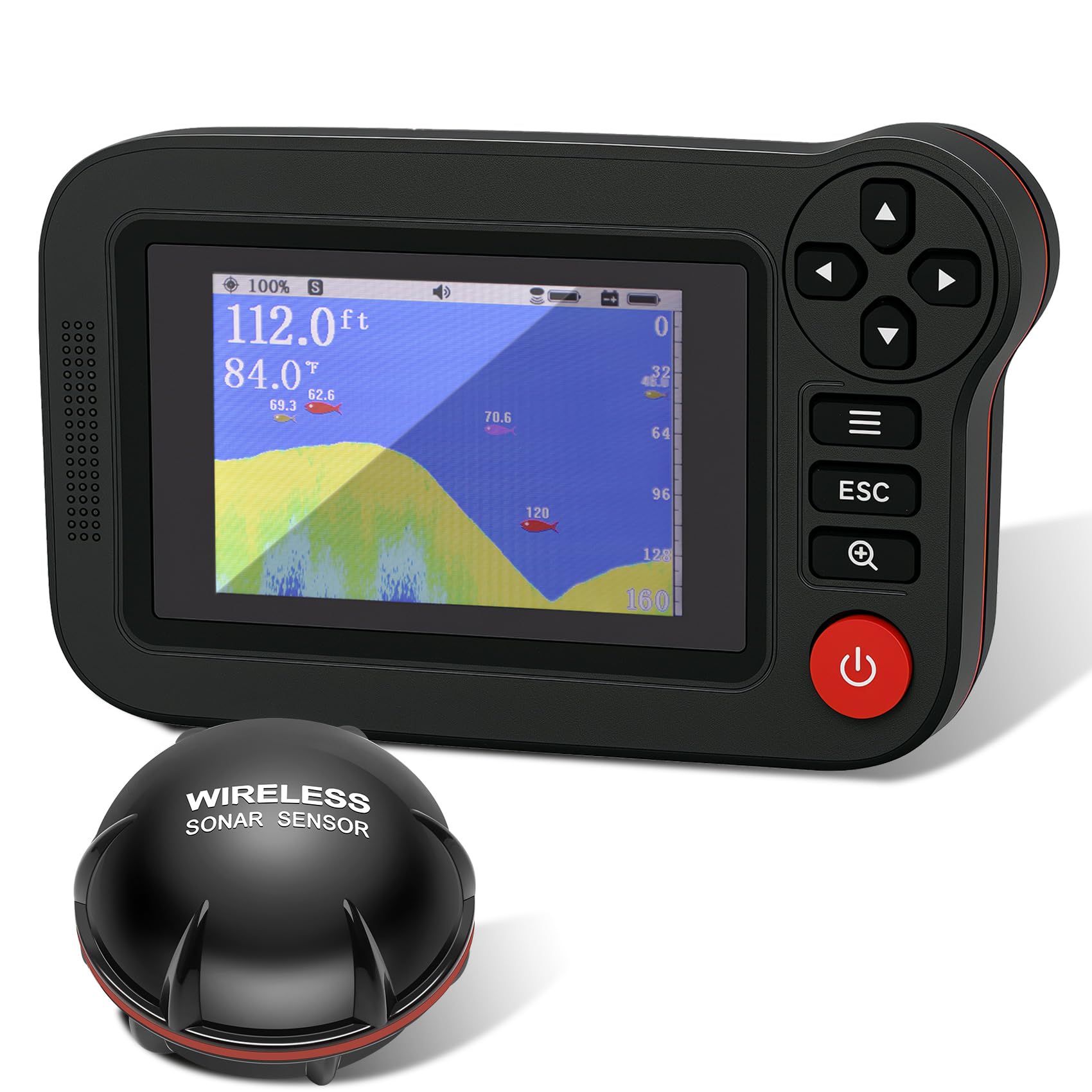
Buy this wireless model for flexible casting from a kayak, shoreline, dock, or small boat where a wired transducer would be inconvenient.
Pros
- Wireless probe eliminates a long transducer cable
- 3.5-inch color LCD with adjustable backlight
- Reports depth, temperature, bottom contour, fish size, and alarms
Cons
- Wireless probe requires separate charging
- Maximum stated depth is 164 feet
- Limited review history compared with established models
The Fuceter pairs a rechargeable sonar ball with a portable screen, so anglers can cast the probe away from the boat or pull it alongside a kayak. Its 105-degree beam covers a broad area, and the screen offers adjustments for sensitivity, depth range, and noise filtering.
The claimed operating time is up to eight hours for the system, though real-world results depend on conditions and settings. The unit is appealing for anglers who move between shore fishing and kayak fishing, since it does not require a permanent transducer mount. Buyers should inspect the charging status before launching and keep the host protected from water.
Buying Guide
The best fish finder for a kayak under $200 should provide useful depth information without making the boat harder to paddle, transport, or launch. The right choice depends mainly on mounting style, display readability, sonar capability, and power management.
Choose the Right Mounting Style
| Mounting approach | Best suited to | What to consider |
|---|---|---|
| Transom or fixed mount | Small boats and stable kayaks | Secure installation and cable routing are important |
| Through-hull mount | Kayaks where drilling is undesirable | Requires compatible hull material and careful positioning |
| Trolling-motor mount | Boats with an electric motor | Keeps the sensor below the water and away from the hull |
| Handheld wired sensor | Portable kayak or rental-boat use | Simple to move, though the cable can become cluttered |
| Wireless castable probe | Shore, kayak, and changing fishing locations | No cable, but the probe must be charged and retrieved |
A removable rail adapter, suction-style mounting solution, or custom bracket can prevent permanent holes in a kayak. The transducer should remain submerged, level, and clear of bubbles created by hull movement.
Prioritize Screen Size and Visibility
A larger screen is easier to read, but it also takes more deck space and may weigh more. A 3.5- to 4.3-inch display is generally a practical range for a small craft when mounted close to the seat.
Adjustable brightness and a readable color display help in direct sunlight. Buttons can be easier to operate with wet hands than a small touchscreen, particularly for beginners wearing gloves.
Compare Sonar Features
Basic sonar can show depth and bottom shape. Dual-beam sonar gives a choice between a narrower view with more detail and a wider search area. CHIRP sonar sends a sweep of frequencies and can improve the separation between nearby targets.
Fish icons and alarms are useful alerts, not proof that a catch is directly beneath the boat. Bottom contours, depth changes, and structure are often more dependable information for deciding where to fish.
Check Power and Water Protection
A fish finder needs a battery that matches the planned trip length. Rechargeable models are convenient for short outings, while fixed units may need a separate 12-volt battery or compatible power pack.
The display and connections should be protected from spray even when the product has a water-resistance rating. Handheld units without waterproof construction should remain in a dry pouch or covered location when conditions become rough.
Consider GPS and Depth Range
GPS waypoint marking is valuable for anglers who revisit the same lakes, channels, brush piles, or drop-offs. A basic portable unit can be sufficient for depth scouting when navigation is handled by a separate device.
Advertised maximum depths are measured under favorable conditions and vary with water clarity, movement, bottom composition, and installation. For most kayak fishing, reliable shallow- and mid-depth performance is more useful than an impressive maximum figure.